
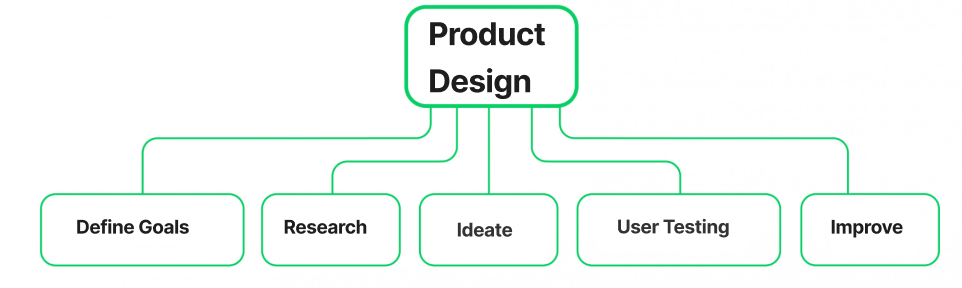
The Product Design Role
In a nutshell, the role of a Product Designer, particularly in the context of YouTap's philosophy, is to lead the design and development of digital products through a human-centred, iterative, and multidisciplinary approach. The designer's primary responsibilities encompass understanding user needs, rapidly prototyping solutions, collaborating with a range of stakeholders, and continuously refining the product based on empirical evidence. The role also extends to articulating design narratives, considering systems-level interactions, and weighing ethical and business implications. This multifaceted role aims to create digital products that are not just functional, but also user-friendly, innovative, and ethically responsible.
In simpler terms, a Product Designer at YouTap focuses on creating digital products that people will find easy and enjoyable to use. They start by understanding what users need and want. Then, they quickly make basic versions of the product to test and improve. They work with other team members like engineers and marketers to make the product better. They also think about the larger impact of the product, such as how it benefits the company and society as a whole. The ultimate goal is to create products that are not just useful, but good for people and the world.
Our Process | Setting Goals
Before we dive into our design process at Youtap, please note that we make a distinction between R&D and BAU request. In short, R&D briefings come from members of the senior leadership (C-Level) and usually describe a general problem or opportunity, covering a wide range of industry use cases.
And BAU briefs usually come from clients, members of the QA team and of course Product Management.
BAU briefs offer a lot more details and come in form of documented specs via Jira and Confluence.
-
How do we measure UX, CX and Product KPIs?
For UX
The KPI review (H.E.A.R.T. framework) will help teams understand improvements, prioritise each KPI's weight, and define new and tangible UX goals. This framework will help with the design process and the whole UX work process including: research, strategy, wireframing, prototyping, testing, and even working with the stakeholders and developers.
The H.E.A.R.T. framework includes five key elements:
-
Human-Centered Design: The design process should be focused on the needs of the users, not on the needs of the designers, business or technical capabilities of your solution.
-
Effective Communication: The design should be easy to understand and use.
-
Appropriate Use of Visuals and Graphics: The design should be visually appealing and easy to understand.
-
Timing and pacing: The design should be easy to use and navigate, and the user should be able to find what they are looking for quickly.
-
Feedback and Interaction: The design should provide feedback and allow the user to interact with the interface.
The steps for conducting a H.E.A.R.T. review for UX include:
-
Defining the goals of the review: The goals of the review should be specific and measurable.
-
Conducting user interviews: User interviews are essential for understanding the user’s needs and how the design meets those needs.
-
Analysing the results of the user interviews: The results of the user interviews should be analysed to determine whether the design meets the goals of the review.
-
Evaluating the design: The design should be evaluated to determine whether it meets the goals of the review.
For CX
Enable quantified financial benefits by measuring four key CX KPIs with your team: retention, cross- and upsell, recommendations, and customer care cost. The KPI review will help teams understand improvements, prioritise each KPI's weight, and define new and tangible CX goals. With ultimate benefits being increased customer retention and higher to cross-sell opportunities.
Track and monitor-
Retention
-
Cross- and upsell
-
Recommendations
-
Customer care cost
-
For Product KPIs
The exercise is ideal for regular product benchmarking initiatives.
The KPI review of the product data is an expert exercise and requires reliable and normalised data, a dedicated data scientist or a product manager with data tracking capabilities. Define all relevant data sets, ensure tracking is in place, and define tracking periods to match with the duration of the experiment.
Activities
-
Define Tracking Periods
-
Define Key Tracking Metrics
-
Identify Product Data Sources
-
Collect Product Data Sets
-
Team playback session
Now that the goals are defined we move to the research phase.
Our Process | The Research
While there are a range of research options, like heuristic research and service research, we will focus on the design and product research for now.
Design Research
The design research part of the workshop is crucial for the overall user interface. It is to be completed with five activities that go over the initial research phase:
-
Desktop research
-
Netnography
-
Moodboard
-
Design set-up
-
Design system set-up
Product Research
The product research deliverable covers the basics of creating the product itself.
The first activity is desk research to identify what it is the product is addressing. Any study that needs to be done on the topic itself or the feasibility of the product is done at this stage. The next activity is a netnography exercise to find people interested in and willing to participate in a study for the product. This is to collect data points for the product. The next activity is a content audit to confirm that all content created for the product is correct. The last activity in this deliverable is a usability testing activity. This is to test the product on real users and understand how they would interact with the product.
-
Desk research
-
Netnography
-
Content audit
-
User testing
Owner: @Unknown user